Showing posts with label QSR. Show all posts

Thursday, October 25, 2012

Subway rises to the QSR Omnichannel Marketing Challenge


Multichannel marketing is defined as the use of many different marketing channels to reach a customer. Better than multichannel marketing is omnichannel marketing which is using one-upping multichannel marketing and linking several channels together to form a cohesive message.   These terms and definitions are simple enough and have been on the front of marketers’ minds for several years.  Why though is it still not practiced as cohesively as it could be, specifically in the quick-service restaurant (QSR) world?   In fact it is so rare in QSR’s that I find it refreshing when it is practiced well.
Thinking about this, I did a check-up on a few QSR’s.  One chain that stood out as a great example is  Subway. They are doing a stellar job promoting their latest limited time offer, the Tuscan Chicken Melt.  Here are several of my observations about what I feel they are doing right.
Web page

On the web, Subway effectively captures the attention of the visitor by splashing the Tuscan Chicken Melt front-and-center on within seconds of opening the web page.  They also effectively engage visitors by throwing out a brief teaser to the promo (above) before the heart of the promo is shown on the web (below). 


Web page
Thirdly, Subway encourages additional engagement with the promo by offering a reason to engage with it and the brand by offering  a grand prize of a trip to Tuscany, Italy.  Clicking on the circled icon takes the visitor to a second marketing channel, Twitter.  Here, visitors are encouraged to upload a photo of the sandwich, along with a Diet Coke and use a Twitter hashtag to enter the contest.
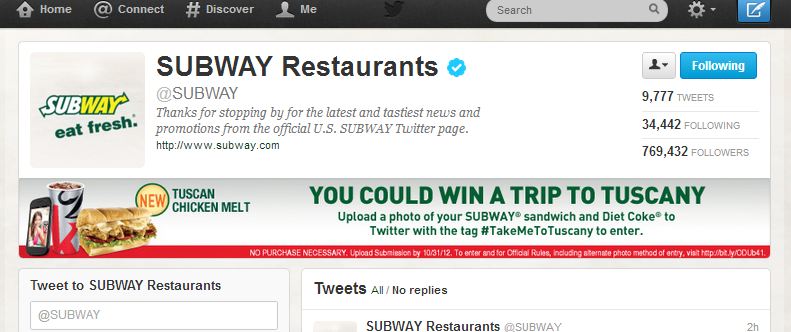
Twitter
Changing over to the next channel – Facebook  - Subway encourages additional participation by highlighting not only the sandwich but what appears to be a photo lodging the contest winner will enjoy.

Facebook

On these three channels  - the web, Facebook and Twitter - Subway clearly does a superb job. But the real test was still to come as I had yet to visit restaurant in person – and this is where I find most restaurants fall short. (I’ll get to why in a bit.)  So, I drove to my local restaurant and, as I pulled in to a parking space, I noticed that they were off to a good start: front-and-center, looking right at me, was a large window decal announcing the Tuscan Chicken Melt. 
Window Decal

As I walked into the restaurant, I was equally impressed with several pieces of POP signage advertising the Tuscan Chicken Melt: on the tops of tables, by the register, above the chips basket, on the beverage cooler and on the menu board.  

Chips basket

Menu Board

Based on this evidence Subway clearly did a great job of promoting the Tuscan Chicken Melt through multiple channels. They also connected the dots for omnichannel marketing as they gave customers an incentive to engage with the promotion on all of the above channels.  Not only that, but the visual of a smart or cell phone in several pieces gave visual clues about how to register for the Twitter contest. 
Let’s revisit the earlier question; why do many QSR’s successfully promote their offerings on all channels except the most important one (at-store)?  I have found that when corporate marketing seeks to get approval for at-store pieces, the process often becomes mired in cumbersome processes taking eight weeks or more, when it should be a one-month turnaround from idea creation to having signage at-store.  For that reason, many marketers throw up their hands in frustration and they end up refusing or not promoting specials well at-store.
But it doesn’t have to be this way: as there is a solution.  Read more about this on the links below:
QSR marketers, are you effectively promoting your offerings, using all available channels, and are they all tied together to form a cohesive, unified, and engaging message?  If not, what is hindering you from doing this?


Thursday, August 2, 2012

Transparency in Engagement Marketing, Part 2


Last week, we partially defined engagement marketing and covered some examples of quick service restaurants and a convenience store chain that put it into practice.  This week we’ll look at a few more examples of how this strategy has worked well for others.  To further define engagement marketing Greg Ippolito, Creative Director of the engagement marketing agency; Annodyne, argues that traditional top-down marketing results, largely, in the production and communication of white noise. Whereas engagement marketing assumes a different approach:

“Think of a salesperson who walks up to you in a store. You tell him thanks, you’re okay, you’re just looking.  But he hovers and looms, finds a way to insert himself into your activity, and is a general annoyance. That’s what typical marketing feels like: intrusive and disruptive.  Engagement Marketing is the opposite. It’s a salesperson who hangs back and engages you if/when you need help. Who can sense what you want to do, and help you arrive at that decision.”  “Engagement Marketing done well, means connecting with audiences who want to hear from you, in relevant, meaningful, interesting ways.”
Domino’s used the power of engagement when in 2010 they reinvented themselves as they made public focus group comments about their pizzas. “Worst excuse for pizza I’ve ever had!”, “the sauce tastes like ketchup” and “totally void of flavor” were some of the comments they made public. Domino’s used these comments as a rallying cry when their CEO, Patrick Doyle stated; “You can either use negative comments to get you down or you can use them to excite you and energize your process and make it a better pizza, we chose the latter.” Everybody in this [headquarters] building, our job is to figure out how to best support them so that we reduce the time and energy that it takes to get done what they need to get done." Source 
Another form of practicing transparency in engagement marketing has been used by an industry as a whole.  Last fall the convenience store industry had a segment on the History Channels Modern Marvels series on convenience stores  In this fascinating piece, viewers were shown the behind the scenes of the convenience store industry.  We see not only the “c-store” industry history but also how the floor plan is methodically planned to optimize revenue in several “zones”.  Take a look at this and you’ll see how even handles on coolers are placed on either the left or right side of the cooler to direct traffic through other profitable c-store zones.

Engagement marketing works well for several reasons, these three being among them:
1.     As is highlighted in the Modern Marvels c-store segment, consumers like to think that they have the inside scoop on what really goes on behind the scenes. This satisfies the sense of curiosity that is indwelt in in all of us

2.     It has a tremendous positive effect on store level employees. What store employee doesn’t want to see his boss get his hands dirty and to have him or her show humility on national television?

3.     Third, it gives “the boss” great ideas to take back to corporate which he or she can then implement. This comes full circle when it is brought back to the store level.
Are you practicing engagement marketing with your consumer and store employees?  What best practices have you put in place, which have had a positive impact on sales, perception in the marketplace and on store employees? 

Tuesday, July 24, 2012

Transparency in Engagement Marketing, Part 1

“Why does your food look different in the advertising than what is in the store”?  This question was recently asked by a consumer and was answered by Hope Bagozzi, Director of Marketing, McDonald’s Canada.  Rather than brushing this question under the rug, McDonald’s seized upon the opportunity and used it to show how food photography  is produced and followed it up with an expose on how secret sauce is made. With a combined 5 million views on their You Tube videos it is easy to see that McDonald’s achieved marketing nirvana by practicing transparency in their marketing efforts.

What does it mean to be transparent in your marketing efforts?   Simply put, it is one of the best ways to practice engagement marketing.  While it is hard to find a concise definition of engagement marketing, it is best defined as:
Engagement Marketing: a marketing strategy that directly engages consumers and employees. It invites and encourages both to participate in the evolution of a brand.
In short, engagement marketing helps customers and store employees develop a relationship with the brand.
Here are some examples that have been used in the quick service restaurant and convenience store industry and why they work:
CBS’s hit series, Undercover Boss, has profiled many industries and has touched the Quick Service Restaurant and C-store industries.  In February, Undercover Boss profiled Checkers restaurants as they went behind the scenes with CEO Rick Silva. 

In one situation, Silva had a tense situation when he encountered a restaurant manager who was verbally abusing his employees.  Silva kept his cool, yet took action when he temporarily closed down the restaurant and rather than fire the manager, chose to have him retrained.  Throughout the piece, Silva showed his poise and humility when he admitted that he had a lot to learn as he had several “Lucille Ball” moments. This is exactly what consumer’s and employees like to see, a boss that freely admits he doesn’t know everything and one that takes decisive actions but treats others fairly.


In another episode of Undercover Boss, 7-Eleven seized on the opportunity to put their CEO, Joe DePinto on the front line.  He was first put on an orange 7-Eleven smock to handle rush hour at a busy store on Long Island. (See this link when DePinto, aka: “Danny” teams up with 18 year store veteran Delores.) DePinto then got to try his hand at making doughnuts in the corporate bakery in Baltimore and thirdly, distribute fresh food and sandwiches on the night shift in North Texas.  Since its premiere, DePinto's Undercover Boss segment has rerun twice on CBS and been picked up all over the world. Like other CEO’s featured on the show, DePinto gained a new appreciation for store-level employees:  "Our franchisees and our store managers are the ones who get it done every day with our customers.  
So what does a leading national franchise do when their focus group tells them that their product is “the worst they’ve ever had? We’ll look at this next week.  We’ll also further define engagement marketing in very practical terms.

Thursday, May 3, 2012

Are You Kidding?

In the not too distant past, when my wife and I were headed out the door on date night, my boys who were at the time, ages 7,5 and 3 asked where we were going.  ”We’re going on a date  to a restaurant!”  “We want to come too,” they said in unison.  Thinking about it for a second and not wanting to spoil the alone time with my wife, I attempted to convince them that they wouldn’t enjoy this kind of restaurant.   “Well guys, I don’t think you’d like this restaurant. You see it rant doesn’t have a play area like at McDonalds, in fact you might even find it boring.  Mom and dad are going out to eat and all we plan to do is just sit and talk most of the time and not even go near a play area,” I said. “No play area? What kind of a restaurant has no play area (?), they responded”  And with that, we were out the door, free to enjoy a leisurely dinner at a restaurant with no play area.
This story was recently brought to mind when I read an article by Out to Eat With Kids founder and CEO, Jennifer Bilbro titled: Tips on creating a kid-friendly restaurant . In this article Jennifer does a great job of outlining some tips on what restaurants should do to make their restaurants not only kid friendly, but parent and adult friendly as well, including the “must have” for kid friendly restaurants, crayons and teaching kids to be responsible with them.  A.D.D. moment:  Am I the only adult “kid” who often colors with those crayons that are intended for kids?
Red Robin
As an experienced father-diner, I thought I’d expand on the fun aspect of kid friendly restaurant tips with my own ideas.
What unique things does the restaurant provide that engage the kids? 
Once when my family and I were at a Carrabba’s Italian Grill, the waiter noticed that we had three kids dining with us and brought over three lumps of pizza dough and asked them to treat it as if it were clay and mold it into a toy.  One made a car, one an airplane and one a spilled coffee cup. (Not really on that last one but it would remind him of his dad.)  After our boys were finished, the waiter took them off to the kitchen, baked them and then brought them out.  Often after this experience, I drove by that restaurant, I thought about how well they engaged their customers, even the non-paying ones.  Our boys also remembered the experience, and never commented that it was boring because it didn’t have a play area. 

Chick-fil-A is masters of being kid friendly.  Their iconic cow exudes fun every day as does their family-friendly atmosphere.  In addition to this, they are masters of local area marketing events where they sponsor school events, concerts and kid oriented community events.   Their annual Cow Appreciation Day, is an opportunity for kids and adults to get a little wacky and dress up as a cow for a free Chick-fil-A meal.  This is also a great way for them to build on tradition.


In my opinion, no restaurant provides a more kid-friendly restaurant than McDonalds.  They are the originator of the Happy Meal,  the aforementioned play area and even though he is semi-retired, Ronald McDonald and  his side kicks, Mayor McCheese, Hamburglar and Grimace.
What are your favorite kid-friendly restaurants and what have they done to not only win your kids over but adults as well?